Why Does Saving Feel Like Losing? The Nervous System After Debt Payoff
You're weeks away from being completely debt-free except for your mortgage. You've spent over a decade digging out. Now you want to set up automatic transfers to savings. But every time you check your checking account and see the balance drop, you feel scared. You know the money's going somewhere good. You know you should feel proud. Instead, you feel like you're losing something. Why Does Saving Feel Like Losing? The Nervous System After Debt Payoff
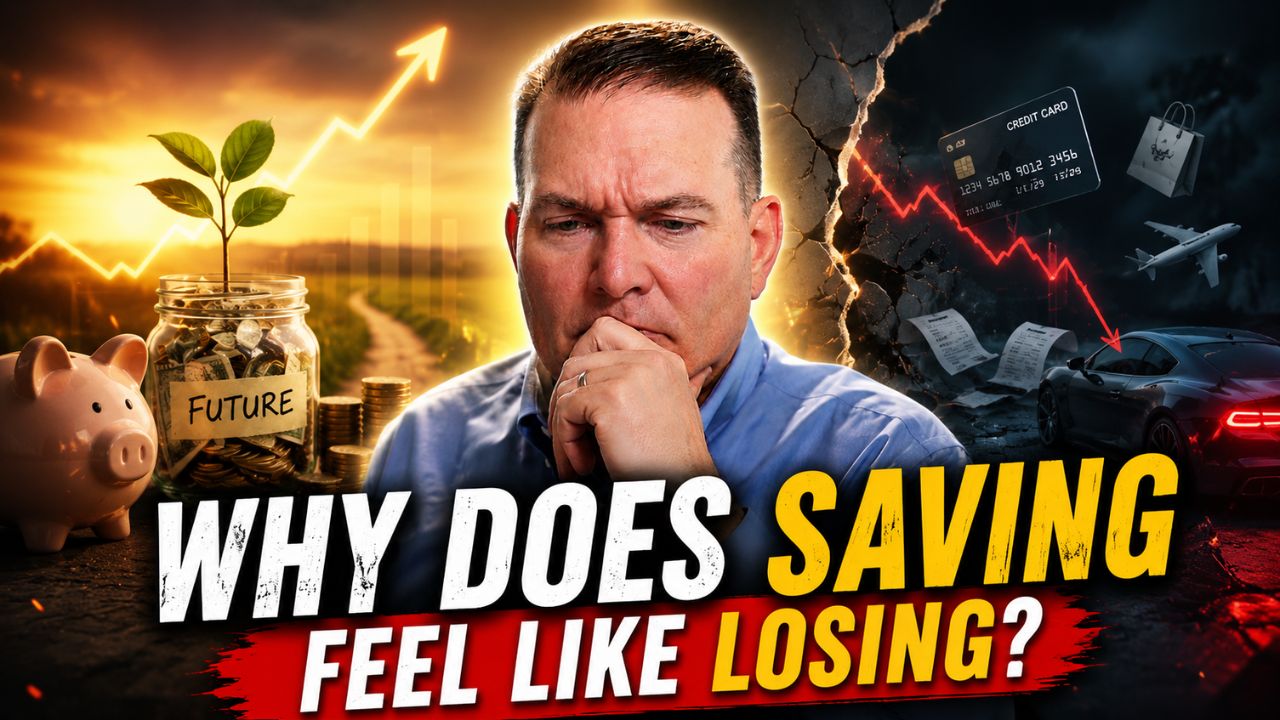
This isn't a money problem. It's a nervous system problem. And your brain is not wrong—it's just running old code.
Your brain learned something during the hard years
When you were in survival mode, a low checking account balance meant danger. It meant late payments. It meant overdraft fees. It meant you were falling behind. Your brain learned to fear that low number because that fear kept you alive financially. It kept you checking that balance every day. It kept you vigilant.
That lesson saved you during the decade you spent clawing your way out of debt.
But now the threat is gone. You've paid off the debt. You have income. You have a plan. The danger isn't real anymore. Your nervous system just hasn't caught up. It's still running the old survival code. When you see that checking account balance drop, your body screams danger because it hasn't received the all-clear signal yet.
This is why saving feels like losing. You've rewired yourself for survival. Now you need to rewire yourself for building. Those are completely different skills.
The truth about that low balance with funded savings
Here's what changed: a low checking account balance ten years ago meant you had no money anywhere. A low checking account balance today means you have a funded savings account, an investment account, and a plan. That's not the same thing at all.
But your brain doesn't know that yet. You're hypervigilant about one number—your checking account. You're not measuring your total financial picture. You're measuring one dashboard while ignoring the others.
The anxiety you're feeling isn't a warning sign. It's a growing pain. And the best part about growing pains is they mean you're actually growing.
Give yourself a floor
Here's the first practical move. Pick a number that feels like breathing room and commit to never going below it in your checking account. Call it your floor. It might be $500. It might be $1,500. There's no wrong answer. Your only job is to pick a number that lets you breathe.
I remember my mom sitting at the dining room table with her old checkbook register, and she told me something I've never forgotten. She said, "I'm so proud of where I am right now. I have $2,000 in my checking account." That was her security blanket. That was her floor.
Setting a floor isn't a weakness. It's not giving up on savings. It's building a system you'll actually stick with. You tell yourself: I won't move money to savings until this floor is covered. Once that floor is solid, then everything extra moves. This removes the guessing and gives your nervous system a boundary it can trust.
Separate your accounts and measure the whole picture
You're checking that checking account balance every day. Stop. Open a savings account at a different bank. Out of sight doesn't mean out of existence, but it removes the temptation to check it constantly. Consider a high-yield savings account with a slight delay in access. The lag is a feature, not a bug. It stops you from draining the account when anxiety hits.
Here's what you need to do instead: measure the whole picture. Think of it like a sandwich. You've got your checking account. You've got your savings account. You've got your investments. Your checking account balance may be lower, but your total number is bigger.
When you're looking at your checking balance and feeling afraid, you're measuring one slice of bread. You need to step back and look at the whole sandwich. That's the number that tells you how you're actually doing.
Build a simple spreadsheet. Add up checking, savings, and investments. Watch that total grow. When you measure the right thing, the anxiety loses its grip.
The 90-day rule
The first month of automatic savings is the hardest. The second month gets easier. By the third month, you won't even think about it.
But you have to get to the third month. And you'll only get there if you commit to ninety days without touching the system. Not ninety days of constantly checking. Ninety days of set it and forget it.
Every time you feel anxiety, every time you want to move money back, every time you question whether this is working—that's when you stop and write down why you started. You're about to be debt-free. You spent ten years building discipline. Now you're in a new phase. You're learning to build something instead of survive. Of course, it feels different. Of course, it's scary.
But you already know how to do hard things. This is just a different kind of hard.
The faith part: wisdom and fear can coexist
Proverbs 21:20 says, "The wise store up choice food and olive oil, but a fool gulps it down." Saving is not just a financial strategy. It's a form of wisdom in Scripture. It's a deliberate, faithful choice.
What makes saving hard after a decade of survival mode isn't laziness. It's rewiring years of learned fear. That's real work. But God honors that work.
Faith doesn't promise you won't feel afraid. It doesn't promise that doing the right thing will feel comfortable. But it does ask that you take the next step even when it feels scary.
You've spent ten years learning to survive. You've done real work. Now you're learning to build. That's the next right step. And when you take it, your nervous system will eventually catch up. It just needs time and proof.
Christian Financial Consulting
Ralph V. Estep, Jr. is a Delaware-based licensed accountant, author, rancher, and media host with more than 30 years of experience in finance, taxation, and small-business leadership. As the founder of Saggio Accounting+PLUS and the creator of the Ask Ralph Media network, Ralph helps entrepreneurs, creators, and everyday families replace money confusion with clarity, confidence, and practical next steps—without shame and without hype.
Ralph’s work blends deep professional expertise with a coach’s mindset and a communicator’s heart. He has held leadership roles across public accounting, financial institutions, law firms, and technology organizations, bringing a rare combination of traditional accounting rigor and modern systems thinking to the people he serves. A graduate of the University of Delaware and Wilmington University (MBA), Ralph is known for turning complex money topics into simple, repeatable frameworks that help people make wiser decisions and build lasting financial stability.
Through Ask Ralph Media, Ralph hosts multiple shows designed to meet people where they are and guide them forward. He is the host of Financially Confident Christian, a daily, faith-based show offering warm, pastoral encouragement for listeners who want peace and practical wisdom with their finances.
He also hosts Truth Unveiled with Ralph, a weekly program that contrasts cultural pressure with biblical truth and invites listeners into deeper spiritual and practical alignment. For small business owners, Ralph leads Grit and Growth Business, spotlighting real sto… Read More

Siblings Inherited Two Rental Properties. Here's How to Decide Without Ruining the Relationship