Overcoming Financial Fear as a Christian

You meet someone at church who's still recovering from 2008. Eighteen years later, and they're still careful. Still watching. Still afraid it could happen again. Overcoming Financial Fear as a Christian

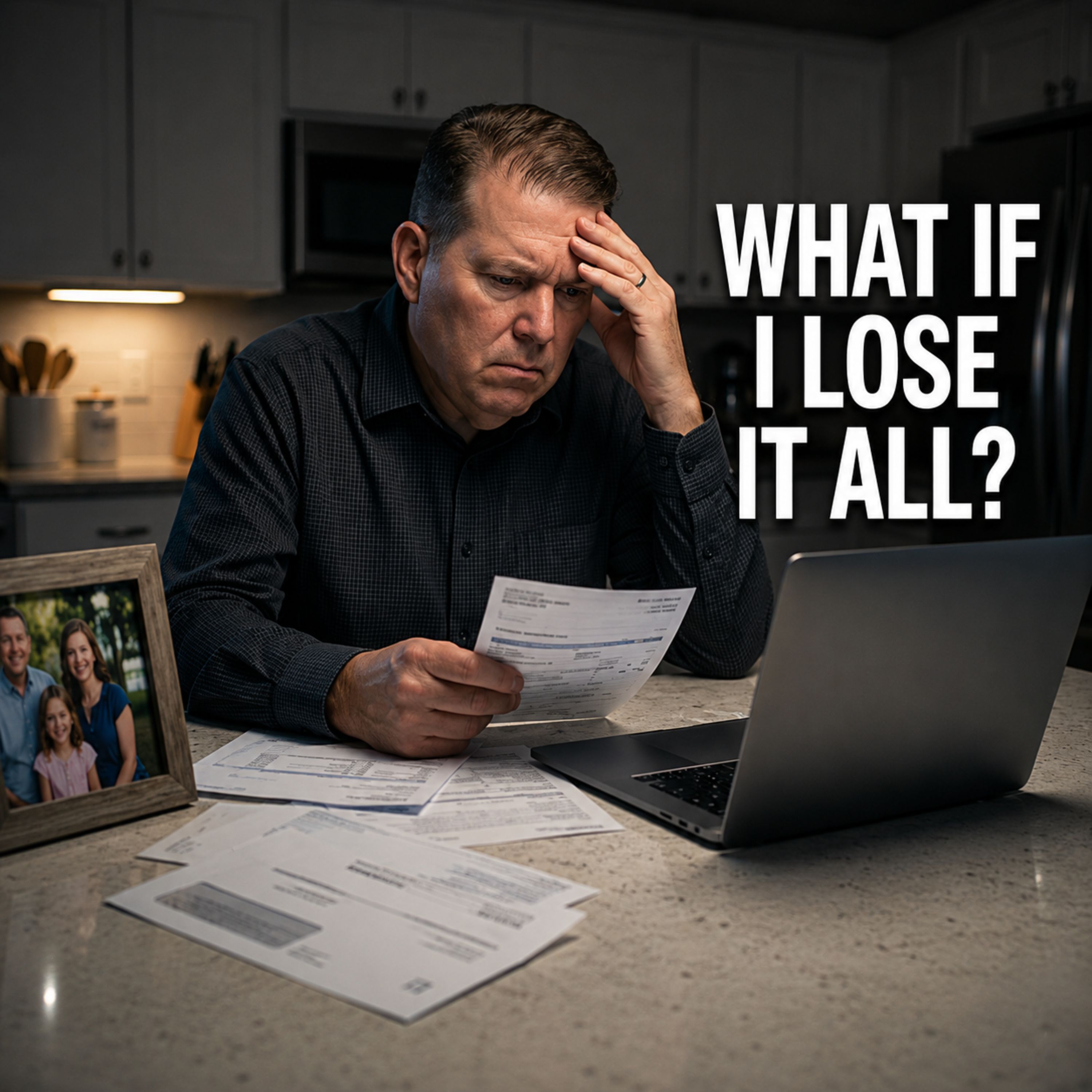
That conversation plants a seed. Suddenly you're thinking about your own life, your own stability. How fast can everything fall apart? What if something happens? The "what ifs" start piling up.
Financial fear is one of the quietest ways we lose sleep.
The Difference Between Smart Caution and Constant Dread
There's a real difference between two things that look the same from the outside: awareness and alarm.
Awareness says, "I should have an emergency fund and insurance." Alarm says, "Something catastrophic is coming and I'll never be prepared enough."
One helps you make a plan. The other keeps you up at night calculating worst-case scenarios.
Both people might have emergency savings. The aware person checks it, feels some relief. The alarmed person checks it constantly and still feels like it's not enough. The money doesn't change the feeling because the problem isn't the money. The problem is the fear running underneath.
Here's what I've learned: you can't control whether hard times come. You can only control whether you prepare wisely and then let that preparation actually calm you, instead of just giving you another thing to obsess about.
What Preparation Actually Looks Like
Preparation isn't perfection. It's not knowing every risk and having a plan for every outcome. That's just another kind of trap.
Real preparation means handling three things:
First, cover the basics. Emergency fund (even if it's small). Insurance (health, auto, home—whatever applies). One small debt payoff so you feel the momentum. This takes time. You don't do it all at once. You do one thing, then the next, then the next.
Second, know what you can actually control. You can't control job loss, medical emergencies, or market downturns. You can control your spending in the categories where you're bleeding money. You can control whether you stay insured. You can control which debts you're paying down. You can control whether you're living above or below your means right now. That's enough.
Third, accept that you'll never have complete control. This is where the faith part matters. You prepare. You plan. You do your part. Then you stop trying to engineer certainty, because certainty doesn't exist. You let yourself be done.
The people I know who sleep best aren't the ones with the most money. They're the ones who did what they could and then actually stopped worrying.
What the Bible Actually Says About This
A lot of people use Matthew 6:34 to shame themselves: "Therefore do not worry about tomorrow, for tomorrow will worry about itself. Each day has enough trouble of its own."
But that's not permission to ignore planning. Jesus said this while acknowledging that tomorrow will have real trouble. He's not saying don't prepare. He's saying don't spend today panicking about tomorrow's trouble.
The opposite direction is equally true. Proverbs is full of stewardship language—budget, save, plan, prepare. That's biblical. Taking wise steps is biblical.
What's not biblical is the place a lot of people get stuck: doing all the right preparation and then spending the next decade convinced it's all going to fail anyway.
Your identity isn't "person who is always three months away from disaster." Your identity is a steward of what you have right now. Do that. Stop trying to engineer certainty you can't have. That's where the peace actually lives.
One Step Forward This Week
Don't overhaul everything. Pick one category where fear is loudest.
Maybe it's medical debt. Maybe it's not having an emergency fund. Maybe it's knowing your insurance is inadequate. Pick the one thing that wakes you up at night most often.
Then do one thing about it. Not everything. One thing.
Open a high-yield savings account and set up a $25 automatic transfer. Get a quote on better insurance. Create a payment plan for the debt instead of avoiding the statement. Sign up for a free financial coaching session.
One action. That's it. Not because it solves everything. Because it moves the needle from "I'm paralyzed by fear" to "I'm taking a step." That movement matters.
The fear doesn't disappear immediately. The money doesn't suddenly feel like enough. One action doesn't fix your whole situation.
One action just means you're not stuck anymore. You're moving.
You Don't Have to Carry This Alone
Financial fear grows bigger in isolation. You carry it quietly, checking your account, doing the math again, wondering if you're the only one thinking like this.
You're not.
Tell one trusted person what you're afraid of. Not everyone. Not your whole life. One person—a friend, a pastor, a mentor—who knows the actual situation and can help you see what's real versus what's catastrophizing.
Shame thrives in secrecy. Clarity grows in the light.
If you want to talk through your specific situation, go to financiallyconfidentchristian.com/question. I answer questions on the show every week, and your question might help someone else who's been carrying the same fear alone.
You're not the only one. And you don't have to figure this out by yourself.
Ralph Estep Jr. The Financial Evangelist
Christian Financial Consulting
Ralph V. Estep, Jr. is a Delaware-based licensed accountant, author, rancher, and media host with more than 30 years of experience in finance, taxation, and small-business leadership. As the founder of Saggio Accounting+PLUS and the creator of the Ask Ralph Media network, Ralph helps entrepreneurs, creators, and everyday families replace money confusion with clarity, confidence, and practical next steps—without shame and without hype.
Ralph’s work blends deep professional expertise with a coach’s mindset and a communicator’s heart. He has held leadership roles across public accounting, financial institutions, law firms, and technology organizations, bringing a rare combination of traditional accounting rigor and modern systems thinking to the people he serves. A graduate of the University of Delaware and Wilmington University (MBA), Ralph is known for turning complex money topics into simple, repeatable frameworks that help people make wiser decisions and build lasting financial stability.
Through Ask Ralph Media, Ralph hosts multiple shows designed to meet people where they are and guide them forward. He is the host of Financially Confident Christian, a daily, faith-based show offering warm, pastoral encouragement for listeners who want peace and practical wisdom with their finances.
He also hosts Truth Unveiled with Ralph, a weekly program that contrasts cultural pressure with biblical truth and invites listeners into deeper spiritual and practical alignment. For small business owners, Ralph leads Grit and Growth Business, spotlighting real sto… Read More

The One Word That Changes How Christians Should Think About Money