
How to Budget on Irregular Income Without the Feast-or-Famine Cycle
How to Budget on Irregular Income Without the Feast-or-Famine Cycle
Every budgeting method assumes one thing: a paycheck that shows up the same size every month. If you cut hair, drive for a living, freelance, or run any kind of gig-based income, that assumption falls apart fast. You don't have a monthly income. You have a guess.
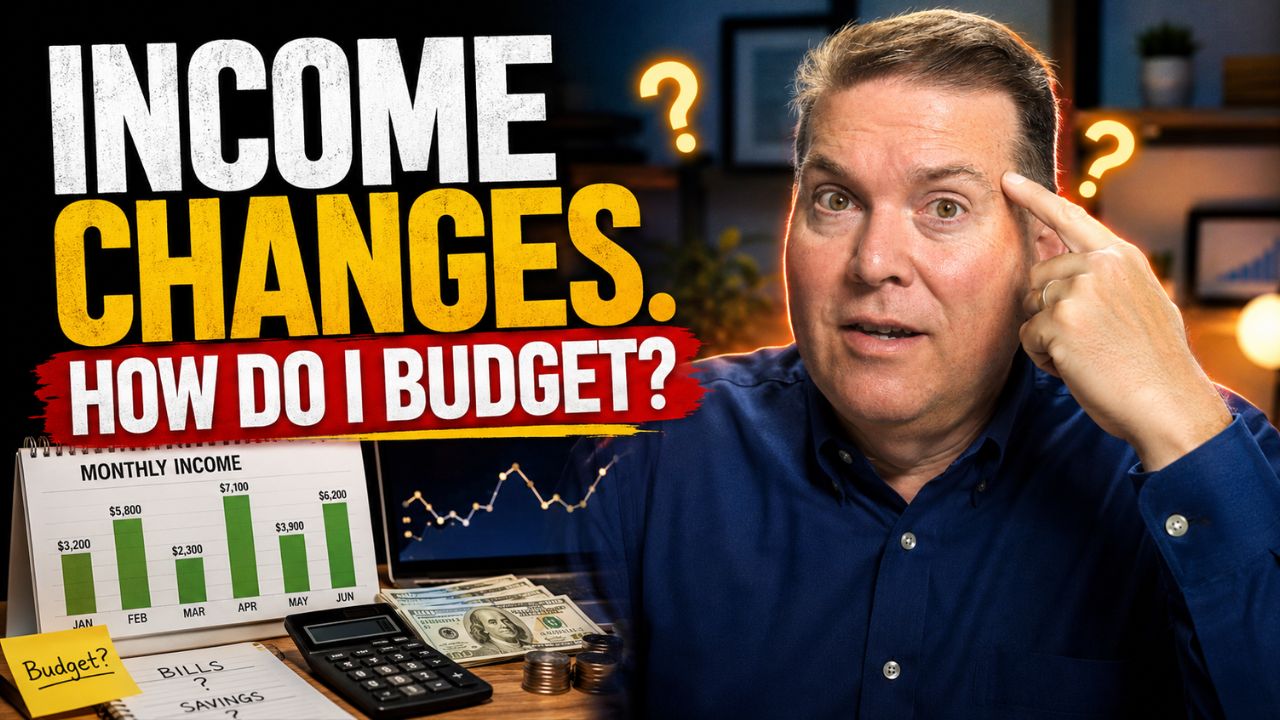
I heard this from a listener who does hair for a living. Some months she's booked solid and feeling flush. Other months are scary slow. Every budgeting video tells her to "take your monthly income and divide it by expenses," and she can't even get past step one. So she stopped budgeting altogether. Good months, she spent too much. Bad months, she leaned on a credit card just to get through, then spent the next good month paying it off. No progress, just a loop.
If that sounds familiar, here's the fix. It's not a new app or a fancier spreadsheet. It's a different starting point.
Start with your worst month, not your average
Pull the last 12 months of income, tips included. Now look at the lowest month you had, not the average. That number becomes your baseline. Build your budget around your rent, utilities, groceries, gas, and minimum payments using that floor.
Here's why this matters. If your budget survives your worst month, every good month stops being a temptation and starts being a bonus. You're no longer white-knuckling it through slow stretches hoping something breaks in your favor.
Get a month ahead of yourself
Once your baseline budget works, the next goal is building one full month of expenses in savings. That buffer means you're always spending money you already earned last month, not money you're hoping shows up this month.
Everything you make above your baseline goes straight into that buffer until it's full. Once you're a month ahead, a slow week stops feeling like an emergency.
Pay yourself a real salary
This is the part most people skip. Set up two accounts: a holding account where all your income lands, and a checking account you actually spend from. Each month, you pay yourself your baseline number into checking. The holding account absorbs the ups and downs.
You end up with a steady paycheck, even when the work behind it isn't steady at all.
Give every good month a job
A surplus month without a plan turns into an overspending month. When income comes in above your baseline, decide in advance where it goes. Extra debt payment. A specific savings goal. Doesn't matter what, as long as it's decided before the money hits your account.
Check in weekly
Ten minutes a week. What came in, what went out, what's coming next week. That's it. This one habit keeps the whole system honest.
The real issue was never the income
If your income has ever felt unpredictable, that doesn't mean you're bad with money. It means nobody ever showed you how to build a system around income that moves. You're not being irresponsible by not having this figured out yet. You just haven't had the framework until now.
Proverbs 27:23 says, "Know the state of your flocks and put your heart into caring for your herds." The instruction was never to have a perfectly steady income. It was to know your numbers and tend to them, even when they change from one week to the next.
Your first step today: pull up your banking app, total your last 12 months of income, and write down your single lowest month. That one number is the foundation everything else gets built on.

Christian Financial Consulting
Ralph V. Estep, Jr. is a Delaware-based licensed accountant, author, rancher, and media host with more than 30 years of experience in finance, taxation, and small-business leadership. As the founder of Saggio Accounting+PLUS and the creator of the Ask Ralph Media network, Ralph helps entrepreneurs, creators, and everyday families replace money confusion with clarity, confidence, and practical next steps—without shame and without hype.
Ralph’s work blends deep professional expertise with a coach’s mindset and a communicator’s heart. He has held leadership roles across public accounting, financial institutions, law firms, and technology organizations, bringing a rare combination of traditional accounting rigor and modern systems thinking to the people he serves. A graduate of the University of Delaware and Wilmington University (MBA), Ralph is known for turning complex money topics into simple, repeatable frameworks that help people make wiser decisions and build lasting financial stability.
Through Ask Ralph Media, Ralph hosts multiple shows designed to meet people where they are and guide them forward. He is the host of Financially Confident Christian, a daily, faith-based show offering warm, pastoral encouragement for listeners who want peace and practical wisdom with their finances.
He also hosts Truth Unveiled with Ralph, a weekly program that contrasts cultural pressure with biblical truth and invites listeners into deeper spiritual and practical alignment. For small business owners, Ralph leads Grit and Growth Business, spotlighting real sto… Read More

Debt snowball vs. debt avalanche: how to pick the right payoff method for you