Debt snowball vs. debt avalanche: how to pick the right payoff method for you

If you've got more than one debt sitting on your plate, you've probably run into this argument already. One camp says pay off your highest interest rate first because it saves you the most money. The other camp says knock out your smallest balance first because you need the win. Both sides talk like the other one is wrong. Debt snowball vs. debt avalanche: how to pick the right payoff method for you
Here's the truth: they're both right. The real question isn't which method is smarter. It's which one you'll actually stick with.
A listener wrote in with four debts: a large credit card sitting near 24% interest, two smaller cards, and a medical bill that's been hanging around for a year. She knew the math said to attack the high-rate card first. But every month she tried, the balance barely moved, and she'd get discouraged and quit. Part of her wanted to just knock out the small cards so she could feel like she was getting somewhere, but then she felt guilty for "ignoring the smart math."
Sound familiar? Let's break down both methods, figure out which one fits how you're wired, and build a plan you'll actually finish.
What is the debt avalanche method?
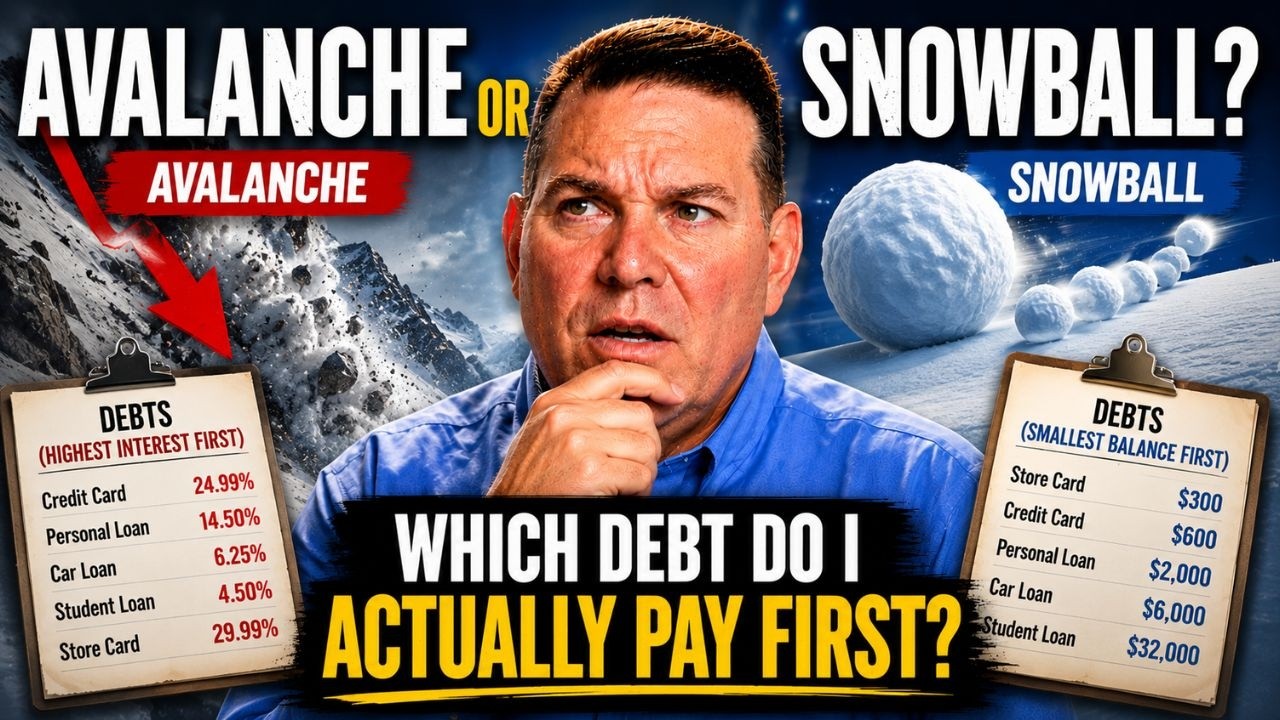
With the avalanche method, you list your debts by interest rate, highest to lowest. You pay the minimum on everything, then throw every extra dollar at the debt with the highest rate. Once that one's paid off, you roll the payment into the next highest rate, and so on.
This is the mathematically optimal way to pay off debt. It saves you the most money in interest over time.
What is the debt snowball method?
The snowball method flips the order. You list your debts from smallest balance to largest, ignoring the interest rate entirely. You pay the minimum on everything, then throw your extra dollars at the smallest balance first.
Once that one's gone, you take the whole payment (minimum plus extra) and roll it onto the next smallest. The payment snowballs as it goes, just like a snowball rolling downhill picks up size and speed.
Which method actually saves more money?
Less than you'd think. Run the actual numbers on most household debt loads, and the dollar difference between avalanche and snowball usually comes out to a couple hundred dollars over the whole payoff period, not thousands.
That's the part people miss when they argue about this online. The math gap is small. The motivation gap is not.
This isn't a smart-versus-dumb decision. It's math-motivated versus momentum-motivated. Both roads get you to zero debt. The only question is which one you'll keep walking.
How to know which method fits you
Ask yourself one question: does watching a balance hit zero light a fire in you, or does knowing you're saving the most money keep you disciplined?
If you're the type who needs to see progress to keep going, and you've quit debt payoff plans before because the big number wasn't moving fast enough, the snowball method is built for you. You need that early win.
If you're the type who can stay focused on a long-term goal even when the early progress is slow, the avalanche method will save you more and won't wear on your motivation the same way.
Neither answer makes you bad with money. It just means you know how you're wired, and that's worth more than picking the method a finance blog told you to pick.
A word of caution if you choose the snowball
If you go with the snowball method and you've got a high-rate card like that 24% one in the listener's story, don't let it sit and grow while you focus on the smaller balances. Keep paying the minimum on it every single month. A balance at that rate can balloon fast if it's ignored.
Two things worth trying while you work through your smaller debts:
Call the card issuer and ask for a lower rate. It costs you nothing to ask, and it works more often than people expect.
Look into a balance transfer to bring that interest rate down. Just be careful not to run the original card back up once it's paid off.
Protect the big debt while you take down the small ones. Guard the giant while you build the strength to face it.
How to make your debt payoff plan actually work
A plan you only keep in your head is just a wish. A plan on autopay is a system.
Here's the setup that removes willpower from the equation:
Go to each debt and set up automatic payment for at least the minimum. Most cards and loans let you check a box for this.
Schedule your extra "attack" payment for a day or two after payday, so the money moves before you're tempted to spend it elsewhere.
Track your progress somewhere you'll actually see it. A chart on the refrigerator, a note on your phone, an app, whatever works. Watching the balance drop is what keeps you going when the process feels slow.
Debt you have to remember to pay is debt you'll eventually forget to pay.
Your first step today
Don't try to solve all four debts today. Just take this one step:
List every debt on one page, smallest balance to largest. Pull the balance and minimum payment for each one. Circle the smallest. That's your target. Then decide on a dollar amount you'll throw at it this month.
You're not paying it off today. You're just drawing the starting line, because you can't win a race you haven't marked the beginning of.
The bigger picture
Wanting to see progress isn't a character flaw. Most of us are wired to need hope to keep moving, and there's nothing dumb about that.
Galatians 6:9 says it plainly: "So don't get tired of doing what is good. At just the right time, we will reap a harvest of blessing if we don't give up."
You're not measured by how fast you climb out of debt. You're measured by whether you keep climbing. Every zero balance, no matter how small, is a win worth celebrating.
Pick your method. Protect your high-rate debt. Automate what you can. And keep going.

Christian Financial Consulting
Ralph V. Estep, Jr. is a Delaware-based licensed accountant, author, rancher, and media host with more than 30 years of experience in finance, taxation, and small-business leadership. As the founder of Saggio Accounting+PLUS and the creator of the Ask Ralph Media network, Ralph helps entrepreneurs, creators, and everyday families replace money confusion with clarity, confidence, and practical next steps—without shame and without hype.
Ralph’s work blends deep professional expertise with a coach’s mindset and a communicator’s heart. He has held leadership roles across public accounting, financial institutions, law firms, and technology organizations, bringing a rare combination of traditional accounting rigor and modern systems thinking to the people he serves. A graduate of the University of Delaware and Wilmington University (MBA), Ralph is known for turning complex money topics into simple, repeatable frameworks that help people make wiser decisions and build lasting financial stability.
Through Ask Ralph Media, Ralph hosts multiple shows designed to meet people where they are and guide them forward. He is the host of Financially Confident Christian, a daily, faith-based show offering warm, pastoral encouragement for listeners who want peace and practical wisdom with their finances.
He also hosts Truth Unveiled with Ralph, a weekly program that contrasts cultural pressure with biblical truth and invites listeners into deeper spiritual and practical alignment. For small business owners, Ralph leads Grit and Growth Business, spotlighting real sto… Read More

When your rent eats 78% of your paycheck, the problem isn't your budget