You're 30 and Never Learned How Money Works. Here's Why That's Not Your Fault.

You're 30 and Never Learned How Money Works. Here's Why That's Not Your Fault.
A listener wrote in this week and said something I hear constantly, just rarely out loud. She's in her early 30s, never learned the basics of money in school, and has spent most of her adult life too busy surviving to catch up. She couldn't pull together $2,000 for an emergency if her life depended on it. And she wanted to know: is it too late?
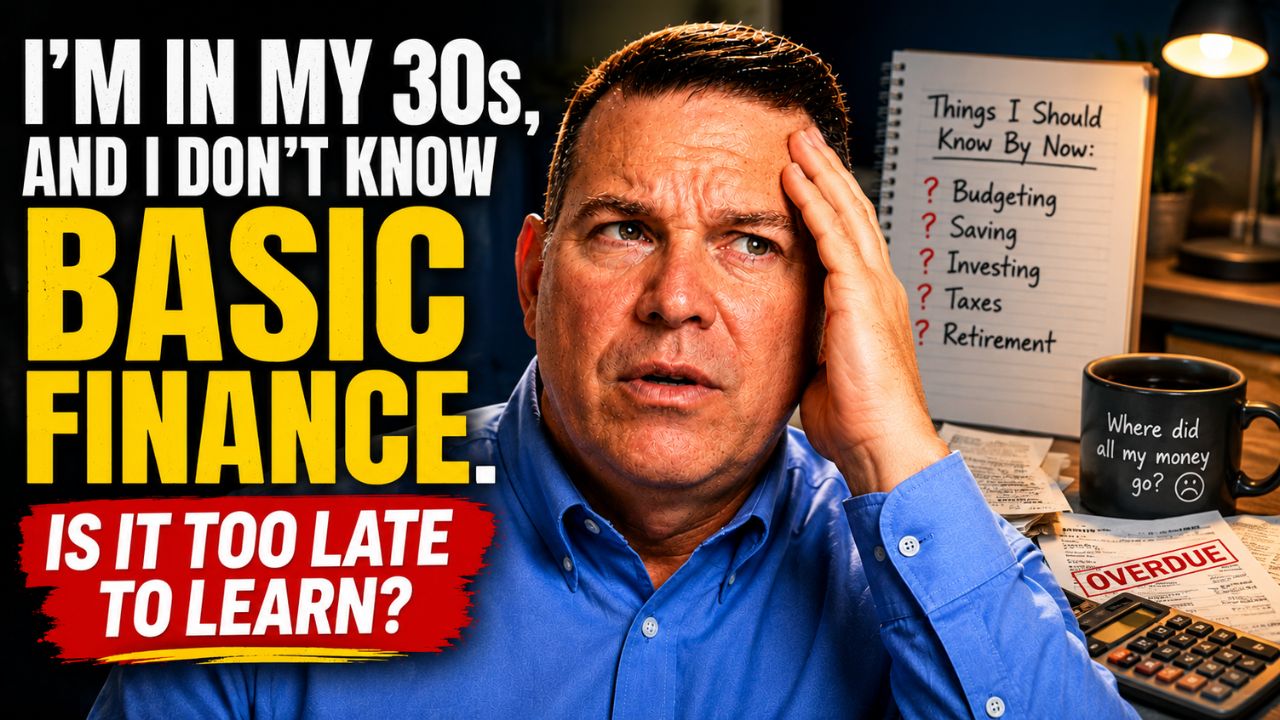
Here's my answer up front. No. And there's actual brain science behind why you're not behind, not just a pep talk.
Stress crowds out learning. That's not a character flaw.
If you've spent years in survival mode, paycheck to paycheck, juggling bills, putting out fires, your brain physically has a harder time absorbing new information. That's not laziness. That's neuroscience. When your nervous system is running on stress, it protects you by narrowing your focus to the immediate threat. Long-term learning takes a back seat.
So if you never picked up the basics, it's probably because nobody ever gave you room to breathe long enough to learn them. Not because you're bad with money.
And you're in more company than you'd think. Most Americans only answer 47% of basic financial literacy questions correctly. Less than half. So the shame spiral of "everyone else already figured this out" isn't based on reality.
Money knowledge breaks down into eight ideas, not eight hundred
The whole subject sounds overwhelming until you see it laid out. It comes down to eight areas: earning, saving, spending, investing, borrowing, insurance, understanding risk, and knowing where to find information you can actually trust.
You don't need to master all eight this month. You need to fill one gap at a time.
Ignore the loud advice. Find one or two sources you trust.
Search anything money-related online and you'll get buried in financial influencers, some genuinely helpful, plenty just chasing clicks. I'll be honest, that noise makes this harder, not easier.
Instead of trying to filter all of it, pick one book, one podcast, or one person whose advice actually makes sense to you, and stick with that for a while. Community colleges, libraries, and nonprofits also run free or low-cost financial courses that are worth a look.
Before you learn to invest, get out of financial fragility
This part surprises people. The first move isn't learning how the stock market works. It's building a small buffer so your brain can stop running on stress and actually take in new information.
Start with $100 a month in savings. It sounds almost too small to matter. But that cushion is what lets your mind shift out of crisis mode and into learning mode. You can't think clearly about investing while you're worried about rent.
Learn slowly. It's the only pace that sticks.
If you're in your 30s, you likely have decades ahead of you. That's not a consolation prize, that's genuinely a lot of runway. Pick one concept a month. Read one financial book a quarter. Make one change every few months.
It's slower than what you'll see on social media, where quick tips come and go and rarely stick. But slow, steady learning is what actually builds lasting habits. And that's really the whole goal here, not a crash course, but a habit you carry for the next fifty years.
You haven't missed your window
Proverbs 13:12 says, "Hope deferred makes the heart sick, but a longing fulfilled is a tree of life." If you're longing to understand your money and stop feeling fragile about it, that longing is worth taking seriously. It gets fulfilled one step at a time, not all at once.
You don't need to catch up on thirty years of missed lessons overnight. You just need to take the next step. And asking the question in the first place means you already have.
Today's win
Pick one concept that scares you, maybe it's credit scores, investing, or emergency funds, and find a single source that explains it clearly. One podcast episode. One article. One video. That's it. You don't need a finance degree by Friday. You just need to understand one more thing than you did yesterday.
Got a money question you'd like answered on the show? Send it to financiallyconfidentchristian.com/question, or leave a voicemail at financiallyconfidentchristian.com/voicemail.

Christian Financial Consulting
Ralph V. Estep, Jr. is a Delaware-based licensed accountant, author, rancher, and media host with more than 30 years of experience in finance, taxation, and small-business leadership. As the founder of Saggio Accounting+PLUS and the creator of the Ask Ralph Media network, Ralph helps entrepreneurs, creators, and everyday families replace money confusion with clarity, confidence, and practical next steps—without shame and without hype.
Ralph’s work blends deep professional expertise with a coach’s mindset and a communicator’s heart. He has held leadership roles across public accounting, financial institutions, law firms, and technology organizations, bringing a rare combination of traditional accounting rigor and modern systems thinking to the people he serves. A graduate of the University of Delaware and Wilmington University (MBA), Ralph is known for turning complex money topics into simple, repeatable frameworks that help people make wiser decisions and build lasting financial stability.
Through Ask Ralph Media, Ralph hosts multiple shows designed to meet people where they are and guide them forward. He is the host of Financially Confident Christian, a daily, faith-based show offering warm, pastoral encouragement for listeners who want peace and practical wisdom with their finances.
He also hosts Truth Unveiled with Ralph, a weekly program that contrasts cultural pressure with biblical truth and invites listeners into deeper spiritual and practical alignment. For small business owners, Ralph leads Grit and Growth Business, spotlighting real sto… Read More

When your rent eats 78% of your paycheck, the problem isn't your budget