Pre-tax vs. after-tax retirement contributions: Which one makes sense for you?
Here's a question I get a lot from listeners in their 30s and 40s: Should I max out pre-tax contributions right now while I'm making good money, or should I split it between pre-tax and Roth? The answer depends on something that sounds simple, but most people get wrong: What will your tax rate actually be in retirement? Pre-tax vs. after-tax retirement contributions: Which one makes sense for you?
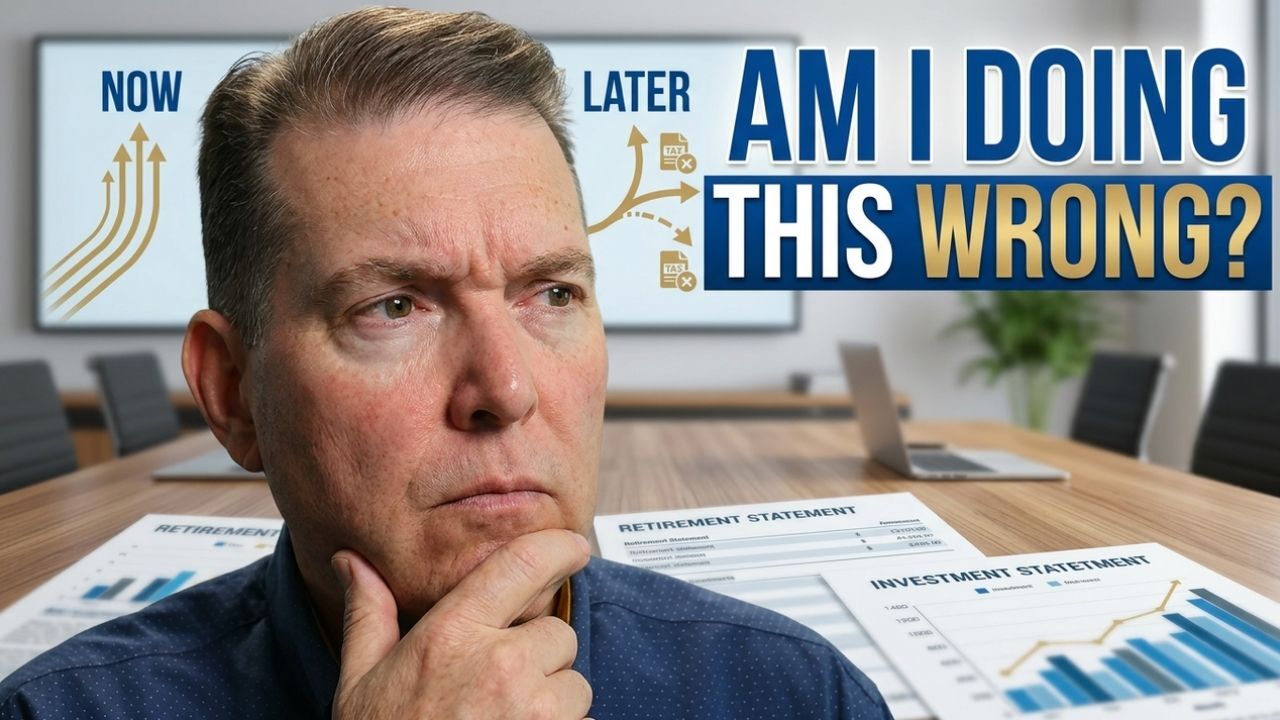
The scenario that changes people's minds
A listener in their early 30s called recently after helping their parent make their first 401(k) withdrawal. Their dad had maxed out pre-tax contributions his whole working life. Now retired, he's in a much lower tax bracket. The listener realized something: Their dad paid full taxes on that money going in, saved on taxes during his earning years, and now has to pay taxes on withdrawals from a lower income. But because he's in a lower bracket in retirement, he's paying less overall. That part worked.
But it also made the listener wonder: What if I'm actually going to have a higher tax rate in retirement than I do now? What if I retire with a pension, investment income, and Social Security all stacked together?
Suddenly, the math changes.
How pre-tax contributions work
Pre-tax money goes into your 401(k), and it lowers your taxable income right now. Let's say you make $120,000 a year and you're in the 24% tax bracket. You contribute $10,000 to your 401(k) pre-tax. Your taxable income drops to $110,000. You save $2,400 in taxes that year.
When you retire and withdraw that money, you'll pay taxes on it then, at whatever your tax rate is in retirement.
This strategy makes sense when you expect to be in a lower tax bracket in retirement. Your dad was. But it's not automatic.
What Roth contributions actually give you
Roth contributions are after-tax. You don't get a tax break today. You pay taxes on that $10,000 now. But when you withdraw it in retirement, you pay nothing. Zero. And your earnings compound tax-free in the meantime.
This sounds less appealing until you realize something: you have control. You know what your tax situation is today. You don't know what tax laws will be in 30 years. You don't know if you'll have more income in retirement than you think.
The three reasons to keep after-tax contributions
Tax laws change. You're betting on what tax rates will be in 2055. I'm not going to predict that for you. But I will say that tax law is unpredictable. Having some money that's already been taxed at your current rate gives you certainty. When you withdraw Roth money in retirement, the government doesn't get a say.
Your retirement income might be higher than you expect. You'll have Social Security. You might have a pension. Your investments will generate income. You might still be working part-time. I've seen retirees end up with higher annual income in early retirement than they made in their 50s. If that's you, those pre-tax withdrawals push your tax bracket up fast.
You've got time for compound growth. If you're 35 and you put $5,000 into a Roth IRA, it has 30 years to grow tax-free. That's powerful. Your 25-year-old coworker? Even more powerful. Don't underestimate what tax-free growth does over three decades.
The strategy that actually works
Don't choose one and ignore the other. Max out your pre-tax 401(k), especially if your employer matches it. That's free money.
Then, if you have more to save, use a Roth IRA. You get $7,000 a year (or $8,000 if you're 50 or older). That's $91,000 over 13 years if you're consistent. In 30 years, with average market returns, that could be $300,000 or more, all tax-free.
If you've already maxed both, look at a backdoor Roth or an after-tax 401(k) option if your plan allows it.
The point is this: diversify your tax situation. You've got pre-tax money. You've got after-tax money. You've got tax-free money. In retirement, you can be strategic about which accounts you pull from, depending on what your income looks like that year.
What you actually need to know
First, figure out your current federal and state tax rates. Not your effective rate. Your marginal rate. That's what matters for this decision.
Second, estimate what you'll actually need in retirement and where it will come from. Social Security, pensions, investment income, and part-time work. Add it up. That tells you roughly what your tax bracket will be.
Third, take full advantage of employer matching in your 401(k). That's an instant 50% or 100% return on your money.
Fourth, understand that this isn't permanent. Your situation changes. Your plan should be flexible enough to adjust.
The bottom line
Tax rates in retirement matter. But you don't know what they'll be. That's why you hedge. You save some money pre-tax, save some after-tax, and when you retire, you have options.
Your job isn't to predict the future perfectly. Your job is to be wise with what you have now and build flexibility into your plan. That's faithful stewardship.
If you've got a specific question about your situation—your income, your employer match, your goals—reach out at financiallyconfidentchristian.com/question. I want to hear what's actually keeping you up at night.
Stay financially savvy.
Christian Financial Consulting
Ralph V. Estep, Jr. is a Delaware-based licensed accountant, author, rancher, and media host with more than 30 years of experience in finance, taxation, and small-business leadership. As the founder of Saggio Accounting+PLUS and the creator of the Ask Ralph Media network, Ralph helps entrepreneurs, creators, and everyday families replace money confusion with clarity, confidence, and practical next steps—without shame and without hype.
Ralph’s work blends deep professional expertise with a coach’s mindset and a communicator’s heart. He has held leadership roles across public accounting, financial institutions, law firms, and technology organizations, bringing a rare combination of traditional accounting rigor and modern systems thinking to the people he serves. A graduate of the University of Delaware and Wilmington University (MBA), Ralph is known for turning complex money topics into simple, repeatable frameworks that help people make wiser decisions and build lasting financial stability.
Through Ask Ralph Media, Ralph hosts multiple shows designed to meet people where they are and guide them forward. He is the host of Financially Confident Christian, a daily, faith-based show offering warm, pastoral encouragement for listeners who want peace and practical wisdom with their finances.
He also hosts Truth Unveiled with Ralph, a weekly program that contrasts cultural pressure with biblical truth and invites listeners into deeper spiritual and practical alignment. For small business owners, Ralph leads Grit and Growth Business, spotlighting real sto… Read More
Should You Keep Giving When You're Deep in Debt? Here's How to Think About It