Should You Save Money or Pay Off Debt First? Here's the Right Order to Do Both
Should You Save Money or Pay Off Debt First? Here's the Right Order to Do Both
Every extra dollar seems to come with a decision attached. Save it for emergencies, or throw it at your debt? Pick one, and it feels like you're neglecting the other.
If that sounds familiar, you're not alone. It's one of the most common questions I get from listeners.
The Question: Save First or Pay Off Debt First?
Here's the question that started this episode, from a listener working through $9,000 in credit card debt with only $600 saved:
"Some people tell me I shouldn't save a penny until every debt is gone because the interest is costing me money. Others tell me I need a full emergency fund before I even think about paying off debt. Whenever I get extra money, I just freeze because I don't know which direction is actually the smart one."
Here's my answer: this was never an either-or decision. It's about putting your money in the right order.
Step 1: Build a Small Safety Net First
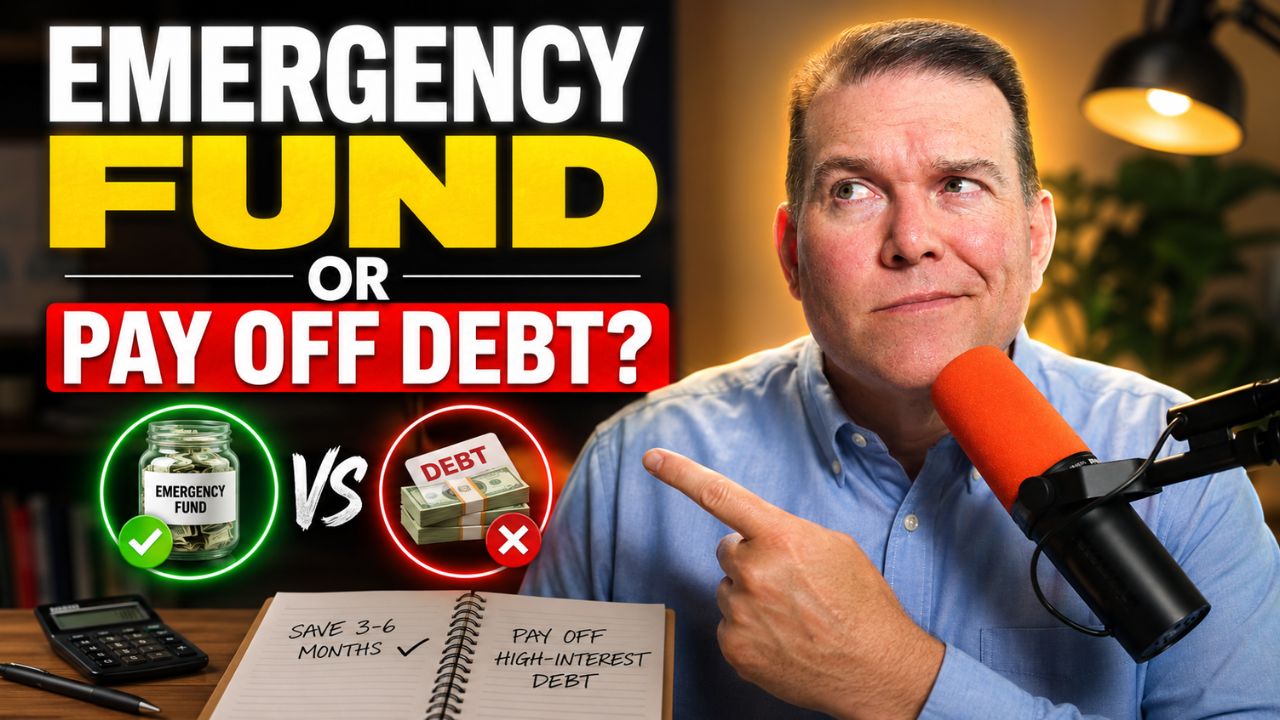
If every surprise expense turns into another credit card charge, the debt cycle never ends. So before you attack debt aggressively, I want you to build a starter emergency fund.
I'm not asking you for the traditional three to six months of expenses here. I want you to start with $1,000. That's enough to cover most everyday emergencies (a car repair, a broken appliance, an unexpected bill) without reaching for a credit card.
Think of it as a financial airbag, not a fortress. You don't need to save for months before you start on debt. You just need enough cushion so one bad week doesn't undo your progress.
Step 2: Attack High-Interest Debt Aggressively
Once that starter fund is in place, I want you to shift every extra dollar toward high-interest debt. Credit card interest rates are averaging in the 20s right now, which means your balance quietly grows even while you're making payments.
Every balance you pay off frees up more of your income and builds momentum. The goal here is consistency, not perfection. I'd rather see you make small, steady payments than wait for the "perfect" month to attack debt harder.
Step 3: Don't Stop Saving Forever
This is the step I see people skip. Once the expensive debt is gone, I want you to go back to saving, this time building toward three to six months of expenses.
In my 30 years of doing this, that's the level of savings that actually creates financial stability. Emergencies stop turning into financial disasters, and peace starts to replace panic.
Step 4: Avoid All-or-Nothing Thinking
Financial progress isn't a straight line. You'll have setbacks. Life will throw curveballs. I've had plenty myself, and one bad month doesn't erase months of good decisions.
Keep moving forward. I believe progress beats perfection every time.
Step 5: Remember the Real Goal
I don't think paying off debt is the actual goal here. It's a step toward the real one: financial freedom. Freedom to be generous. Freedom to have options. Freedom that reduces stress and strengthens your family.
Every wise financial decision you make now is an investment in that freedom.
A Faith Perspective on Saving and Paying Off Debt
Here's what I believe: faith doesn't remove the need for wise planning, and wise planning doesn't mean you're lacking faith. The two work together.
Faith doesn't promise you won't face emergencies, or that debt will vanish overnight, or that you won't hit hard seasons. I know, because I've had those seasons too. What faith does promise is wisdom for those who ask for it, and a God who walks with you through every step.
Saving isn't a lack of faith. Paying down debt isn't a lack of trust. I see both as stewardship.
As Proverbs 21:20 puts it: "The wise have wealth and luxury, but fools spend whatever they get."
Today's Win: Your Starter Emergency Fund
-
Check your current savings balance.
-
Set your target (I'd start around $1,000).
-
Automate a weekly transfer toward that goal.
-
Once it's funded, redirect that money toward your highest-interest debt.
I believe small wins like this build the momentum that gets you to real financial confidence.
Have a financial question? Send it in at financiallyconfidentchristian.com/question.
Christian Financial Consulting
Ralph V. Estep, Jr. is a Delaware-based licensed accountant, author, rancher, and media host with more than 30 years of experience in finance, taxation, and small-business leadership. As the founder of Saggio Accounting+PLUS and the creator of the Ask Ralph Media network, Ralph helps entrepreneurs, creators, and everyday families replace money confusion with clarity, confidence, and practical next steps—without shame and without hype.
Ralph’s work blends deep professional expertise with a coach’s mindset and a communicator’s heart. He has held leadership roles across public accounting, financial institutions, law firms, and technology organizations, bringing a rare combination of traditional accounting rigor and modern systems thinking to the people he serves. A graduate of the University of Delaware and Wilmington University (MBA), Ralph is known for turning complex money topics into simple, repeatable frameworks that help people make wiser decisions and build lasting financial stability.
Through Ask Ralph Media, Ralph hosts multiple shows designed to meet people where they are and guide them forward. He is the host of Financially Confident Christian, a daily, faith-based show offering warm, pastoral encouragement for listeners who want peace and practical wisdom with their finances.
He also hosts Truth Unveiled with Ralph, a weekly program that contrasts cultural pressure with biblical truth and invites listeners into deeper spiritual and practical alignment. For small business owners, Ralph leads Grit and Growth Business, spotlighting real sto… Read More
The Hidden Math Behind Buy Now, Pay Later Purchases