
Why Your Electric Bill Jumped $55 This Summer (And What Actually Fixes It)

Why Your Electric Bill Jumped $55 This Summer (And What Actually Fixes It)
You open your bill and it's $205. Last month it was $150. You haven't changed a thing about how you're living, but somehow you owe $55 more. It feels random. It isn't.
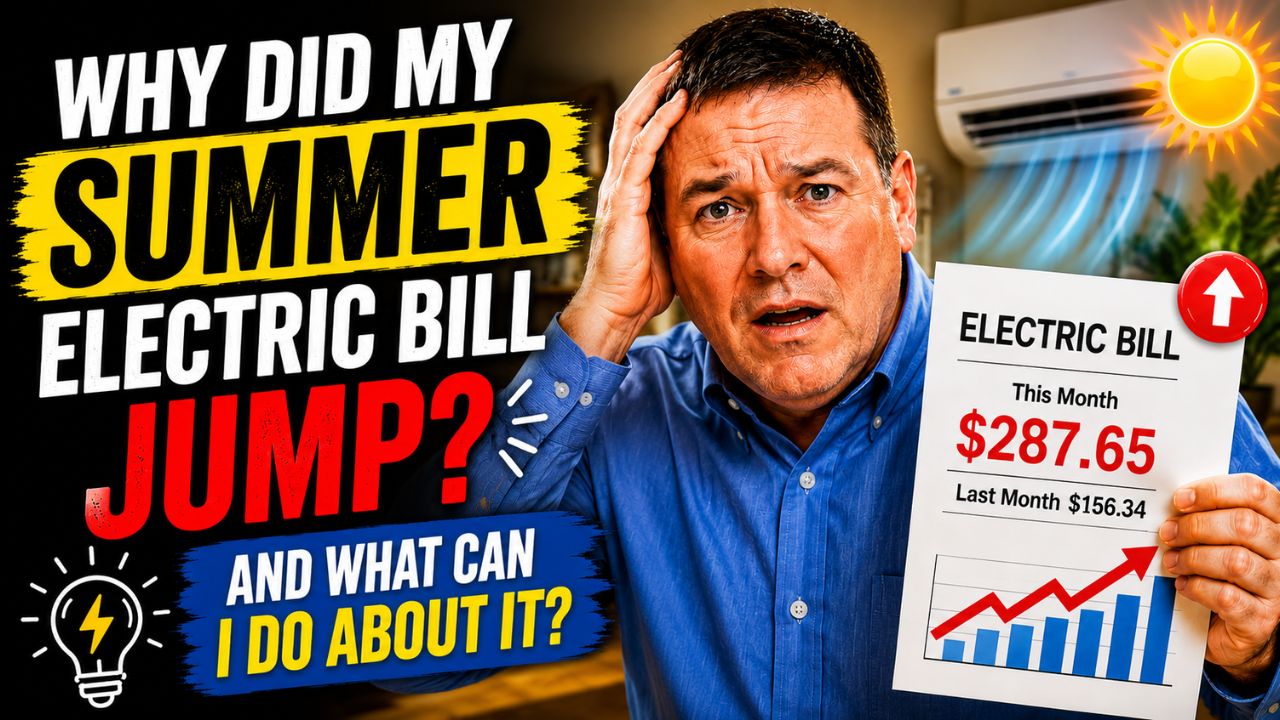
A listener wrote in with exactly this problem this week, and I get it, because it's been over 100 degrees here in Middletown, Delaware the last few days. Hot enough that my church softball league canceled games. So before you assume you're just stuck paying whatever shows up, let's find out where that money actually went.
Three things drive your summer spike
Your bill isn't jumping for one mysterious reason. It's usually some combination of three things: the utility's rate structure, how efficient your appliances are, and when you're running them. You can't do much about the first one, and you definitely can't change the weather. But the other two? Those are yours to work with.
Start by finding out where the money's going
Most people never actually look at their bill past the total due. If your utility charges peak and off-peak rates, that's usually worth a few extra cents per kilowatt hour during the afternoon and early evening. Pull up your bill and write down the times and the rate difference. You can't fix a leak you haven't found.
Three appliances drive about 60% of most summer bills: air conditioning, the refrigerator, and water heating. Yes, water heating, which is a little funny when you think about it. We spend all day cooling the house down just to jump in a hot shower.
Shift when you run things
If your utility has peak and off-peak pricing, run the dishwasher and the laundry after 9 p.m. or before 7 a.m. A cheap timer makes this automatic. You're not using less electricity; you're just paying less for the same electricity. That alone can save $20 to $40 a month, depending on your rate plan. If your area doesn't do time-based pricing, this one won't move the needle for you, and that's fine. Not every tip applies to every house.
Hunt down phantom power
Coffee makers, phone chargers, cable boxes, gaming consoles. All of them pull power even when they're off. Plug your entertainment center into a power strip and flip it off at night. One woman who used to work with me at the credit union installed a breaker switch and killed power to that whole side of the house every time she left. That's probably more than you need to do, but a 30-second scan of what's plugged in can save $5 to $15 a month.
Do the thermostat math
Here's the one that gets people. On a 95-degree day, a thermostat set at 72 is trying to close a 23-degree gap. Set it at 78 instead, and that gap drops to 17 degrees, a 26% smaller job for your AC. You don't have to live without air conditioning. Just ask whether you can hold at 77 or 78 during the day and let it drop back down at night. A programmable thermostat usually pays for itself within a few months of summer savings, and adjustments like this can save $30 to $50 a month on their own.
Pull your last three bills
Compare this June and July to last year's. That tells you whether this jump is a normal summer swing or something's actually wrong, like an appliance drawing more power than it should. Once you've made a change or two, track the next two bills and see if the number actually moves. When it does, that's real money back in your pocket, and it's worth noticing.
You're not stuck with it
Faith doesn't promise the utility company will charge you less, and it doesn't promise the heat will break early. But Proverbs 27:12 says the prudent see danger and take precautions, while the simple keep going and pay the penalty. The gap between resignation and stewardship is one sentence. Resignation says "this just happens to me." Stewardship says "I can do something about this."
You're not helpless here. Pick one thing from this list, check your peak hours, adjust the thermostat, hunt the phantom loads, and start there.
Got a money question of your own? Send it in at financiallyconfidentchristian.com/question, or leave a voicemail at financiallyconfidentchristian.com/voicemail.

Christian Financial Consulting
Ralph V. Estep, Jr. is a Delaware-based licensed accountant, author, rancher, and media host with more than 30 years of experience in finance, taxation, and small-business leadership. As the founder of Saggio Accounting+PLUS and the creator of the Ask Ralph Media network, Ralph helps entrepreneurs, creators, and everyday families replace money confusion with clarity, confidence, and practical next steps—without shame and without hype.
Ralph’s work blends deep professional expertise with a coach’s mindset and a communicator’s heart. He has held leadership roles across public accounting, financial institutions, law firms, and technology organizations, bringing a rare combination of traditional accounting rigor and modern systems thinking to the people he serves. A graduate of the University of Delaware and Wilmington University (MBA), Ralph is known for turning complex money topics into simple, repeatable frameworks that help people make wiser decisions and build lasting financial stability.
Through Ask Ralph Media, Ralph hosts multiple shows designed to meet people where they are and guide them forward. He is the host of Financially Confident Christian, a daily, faith-based show offering warm, pastoral encouragement for listeners who want peace and practical wisdom with their finances.
He also hosts Truth Unveiled with Ralph, a weekly program that contrasts cultural pressure with biblical truth and invites listeners into deeper spiritual and practical alignment. For small business owners, Ralph leads Grit and Growth Business, spotlighting real sto… Read More

When your rent eats 78% of your paycheck, the problem isn't your budget