
You Don't Need $3,000 to Start an Emergency Fund. You Need $500.

A listener wrote in this week with a problem a lot of hardworking people share. She and her husband both work full time. No fancy coffee habit, no new gadgets. But by the time rent, groceries, the car payment, and daycare come out, there's nothing left. Some months they're short. Every time something breaks- a car repair, a dentist bill, new shoes for the kid- it lands on a credit card she's still paying off months later. You Don't Need $3,000 to Start an Emergency Fund. You Need $500.
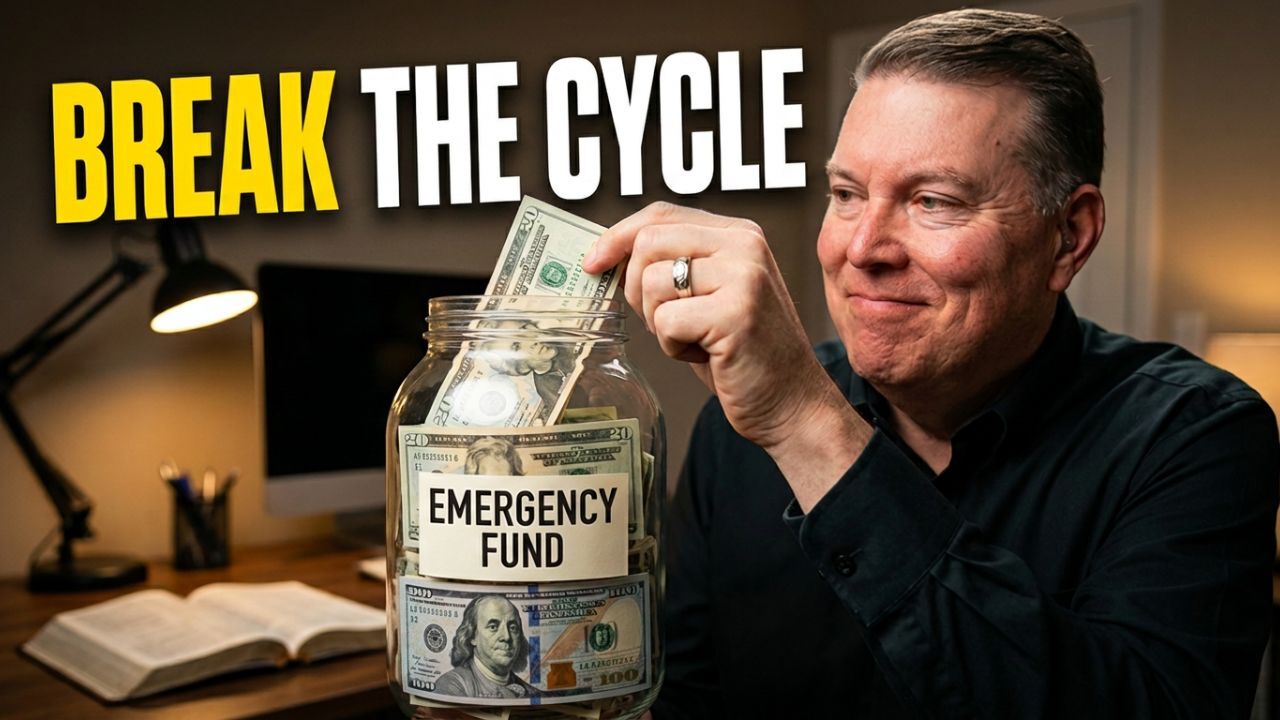
She wasn't asking me to tell her to save more. She already knows that's not the problem. Her real question was simpler and harder: where does the money even come from when there isn't any?
Here's the answer. An emergency fund doesn't start with extra money. It starts with a different system.
Forget three to six months. Aim for $500.
Every financial expert tells you to save three to six months of expenses. That number is so big it stops people before they start. So throw it out for now.
Aim for $500 instead. That covers most of the small emergencies that usually end up on a credit card: a car repair, an urgent copay, a flat tire. And $500 is reachable. Find $10 a week, and you'll get there in a year. Find $20 a week, and you'll get there in six months.
The goal isn't to get rich. It's to break the cycle where every emergency turns into new debt.
Find the $20 you're already losing
Before you try to earn more, look at what's already leaking out. Pull your last 30 days of bank and credit card statements and read every line.
Subscriptions people forget they're paying for. Streaming services nobody's watched in months. Free trials that quietly started charging. Convenience store runs that add up faster than they seem to. Most people who actually sit down and look find $20 a week within about 15 minutes.
Automate it so you never have to decide twice
The money you have to remember to save is the money that disappears. Open a separate savings account, ideally at a different bank than your checking account, so it's a little out of reach. Then set up an automatic transfer for the day after payday. Even $10 or $20.
This takes willpower out of the equation entirely. You won't feel motivated every week, and that's fine, because the system doesn't need your motivation once it's running.
Catch windfalls before they hit your checking account
Your paycheck isn't the only money that shows up during the year. Tax refunds, rebates, birthday cash, overtime, bonuses, all of it counts. Decide in advance that a chunk of any windfall goes straight to savings before it ever touches your checking account.
A $1,000 tax refund with half routed to savings gets you to that $500 goal in one shot. The trick is deciding where the money goes before it arrives, because once it's sitting in your checking account, you'll find something else to do with it.
Define what counts as an emergency before you need to decide
A fund you raid for anything isn't an emergency fund; it's just a slush fund. So write down, in advance, what actually qualifies: urgent, necessary, and unexpected. A car breaking down when you need it for work. A medical need. Keeping the lights on.
A sale at your favorite store doesn't count. A vacation you've been wanting doesn't count either, even if it's been years. Deciding this ahead of time means you're not negotiating with yourself in a weak moment. And when you do use the fund for a real emergency, that's not a failure. That's the fund doing exactly what it's for.
This isn't about being bad with money
If you feel like you're on a treadmill that keeps speeding up, that doesn't mean you're failing. It means you're tired, and tired people are usually the ones working the hardest.
Faith doesn't promise the car won't break down or that next month will be easier. But Matthew 6 reminds us that the God who feeds the birds knows what's on your kitchen table too. Your worth was never measured by your bank balance.
Zechariah 4:10 says, "Do not despise these small beginnings, for the Lord rejoices to see the work begin." Ten dollars a week can feel like nothing against everything you're worried about. It's still a beginning, and beginnings are where things change.
Today's win
Open a separate savings account today. It takes about 10 minutes online. You don't need to fund it yet, just build the container. You can't fill a jar you haven't bought.
Got a question of your own? Send it to financiallyconfidentchristian.com/question, or leave a voicemail at financiallyconfidentchristian.com/voicemail.

Christian Financial Consulting
Ralph V. Estep, Jr. is a Delaware-based licensed accountant, author, rancher, and media host with more than 30 years of experience in finance, taxation, and small-business leadership. As the founder of Saggio Accounting+PLUS and the creator of the Ask Ralph Media network, Ralph helps entrepreneurs, creators, and everyday families replace money confusion with clarity, confidence, and practical next steps—without shame and without hype.
Ralph’s work blends deep professional expertise with a coach’s mindset and a communicator’s heart. He has held leadership roles across public accounting, financial institutions, law firms, and technology organizations, bringing a rare combination of traditional accounting rigor and modern systems thinking to the people he serves. A graduate of the University of Delaware and Wilmington University (MBA), Ralph is known for turning complex money topics into simple, repeatable frameworks that help people make wiser decisions and build lasting financial stability.
Through Ask Ralph Media, Ralph hosts multiple shows designed to meet people where they are and guide them forward. He is the host of Financially Confident Christian, a daily, faith-based show offering warm, pastoral encouragement for listeners who want peace and practical wisdom with their finances.
He also hosts Truth Unveiled with Ralph, a weekly program that contrasts cultural pressure with biblical truth and invites listeners into deeper spiritual and practical alignment. For small business owners, Ralph leads Grit and Growth Business, spotlighting real sto… Read More

You're 30 and Never Learned How Money Works. Here's Why That's Not Your Fault.