How Do You Talk to Your Kid About Money When You Think They're Wrong

How Do You Talk to Your Kid About Money When You Think They're Wrong
He didn't come home angry about nothing. He came home with a $40,000 loan balance and two years of house hunting that went nowhere, and he landed on a word for it. Capitalism is evil. That's the sentence a listener's 24-year-old son said at her dinner table this Christmas, and nobody talked for the rest of the night.
If you've had a version of that conversation with your own kid, here's what actually works, and it's not the argument most parents reach for first.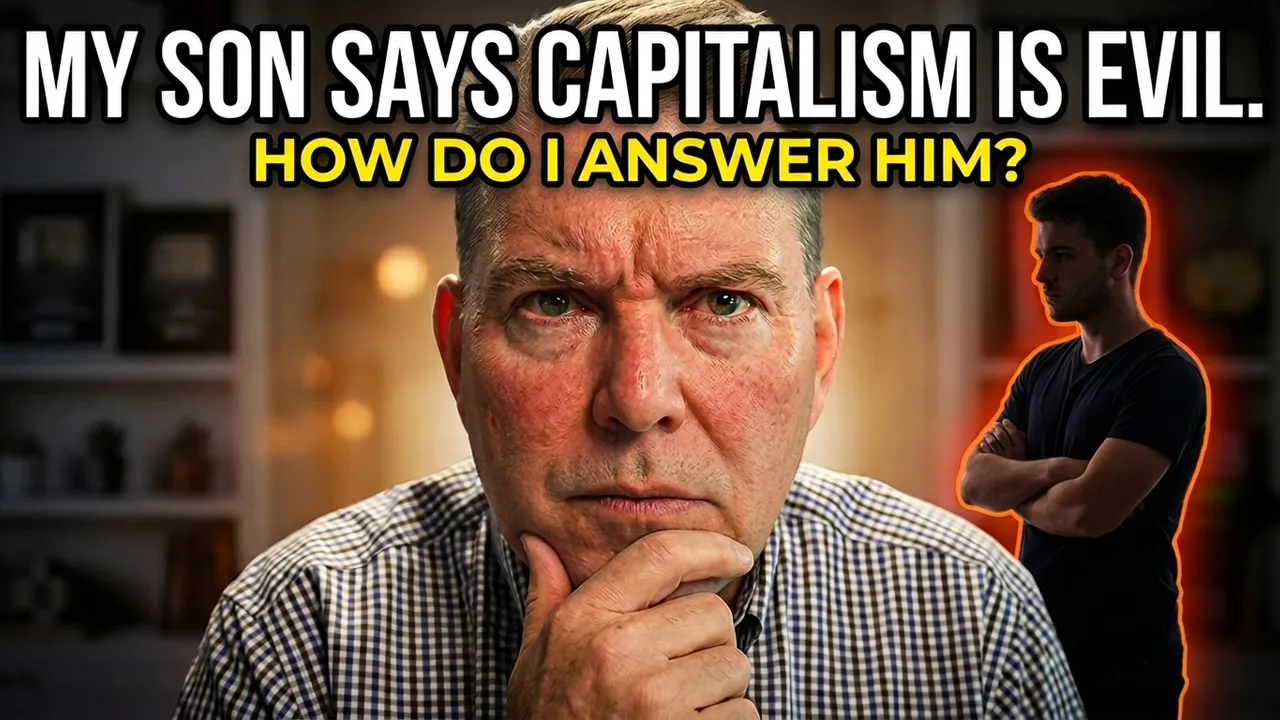
The grievances are usually real
Before you correct the word he used, check whether the feeling underneath it is true. In this case it was. The median age of a first-time homebuyer hit 40 last year, an all-time high. Student loan debt in this country sits around $1.84 trillion across 43 million borrowers. His $40,000 isn't unusual. It's ordinary.
Gallup found that positive views of capitalism dropped to 54 percent last year, the lowest they've ever recorded. That's not one angry kid. That's a generation looking at the same numbers and reaching the same conclusion.
You can't talk someone out of a bad answer until you've admitted the question behind it is real.
You might be arguing about two different things
Here's where most of these conversations go sideways without anyone noticing. When a lot of young people say "socialism," they mean Denmark. Healthcare, tuition, paid leave, a strong safety net. When their parents hear the word, they picture something else: the government owning the factories, setting prices, assigning housing.
Those aren't the same system, and the mix-up is doing most of the damage.
Denmark's own prime minister addressed this directly at Harvard in 2015: "I would like to make one thing clear. Denmark is far from a socialist planned economy. Denmark is a market economy." Sweden has no inheritance tax and no wealth tax. Denmark funds its safety net with a 25 percent sales tax on nearly everything, and its top income bracket kicks in around one and a half times the average income, roughly $90,000 in American terms. That's not "the rich pay for it." That's everyone pays for it.
There's a legitimate argument to have about how much government we want and what we're willing to pay for it. That's a debate about size. It's a different debate entirely from whether anything stays outside government's reach at all, and that second one is where the real risk sits.
Ask one question instead of giving a lecture
A history lecture will get you tuned out in under two minutes. One question tends to land instead: "Who, specifically, do you trust with that much power?" Not government in the abstract. The actual one, staffed eventually by people your son likes least, because that's how elections work. Every power built for one side becomes a power handed to the other side on a schedule.
Roughly 7.9 million people have left Venezuela, one of the largest displacement crises on the planet, out of a country that was once the wealthiest in South America. Nobody there voted for empty shelves. They voted to stop being poor. Nobody votes for the ending. They vote for the beginning, and the beginning always sounds compassionate.
What actually moves someone
Skip the debate and do one concrete thing together. Sit down and look at the real loan number, the interest rate, an actual payoff date. Most people carrying debt have never seen it laid out plainly, and something shifts once the fog becomes a figure. Same with the house search: down payment, monthly payment, timeline. A target instead of a grievance.
Then go look at your own county's zoning board, because the housing shortage he's angry about is mostly a legal problem, not a natural one. Those meetings are open to the public, and almost nobody shows up. Bring him to one.
He'll stop wanting to tear the system down the day he watches somebody actually repair a piece of it.
I wrote a longer piece on the bigger version of this argument, including what history actually shows about how these systems fail and why the failure isn't about who's in charge. If you want the fuller case, read Free Isn't Free.
Want to hear the full conversation, including the faith side of this and exactly what to say tonight? Listen to today's bonus episode of Financially Confident Christian.
Christian Financial Consulting
Ralph V. Estep, Jr. is a Delaware-based licensed accountant, author, rancher, and media host with more than 30 years of experience in finance, taxation, and small-business leadership. As the founder of Saggio Accounting+PLUS and the creator of the Ask Ralph Media network, Ralph helps entrepreneurs, creators, and everyday families replace money confusion with clarity, confidence, and practical next steps—without shame and without hype.
Ralph’s work blends deep professional expertise with a coach’s mindset and a communicator’s heart. He has held leadership roles across public accounting, financial institutions, law firms, and technology organizations, bringing a rare combination of traditional accounting rigor and modern systems thinking to the people he serves. A graduate of the University of Delaware and Wilmington University (MBA), Ralph is known for turning complex money topics into simple, repeatable frameworks that help people make wiser decisions and build lasting financial stability.
Through Ask Ralph Media, Ralph hosts multiple shows designed to meet people where they are and guide them forward. He is the host of Financially Confident Christian, a daily, faith-based show offering warm, pastoral encouragement for listeners who want peace and practical wisdom with their finances.
He also hosts Truth Unveiled with Ralph, a weekly program that contrasts cultural pressure with biblical truth and invites listeners into deeper spiritual and practical alignment. For small business owners, Ralph leads Grit and Growth Business, spotlighting real sto… Read More
Renting vs. Buying: My 25% Rule for Figuring Out What You Can Actually Afford