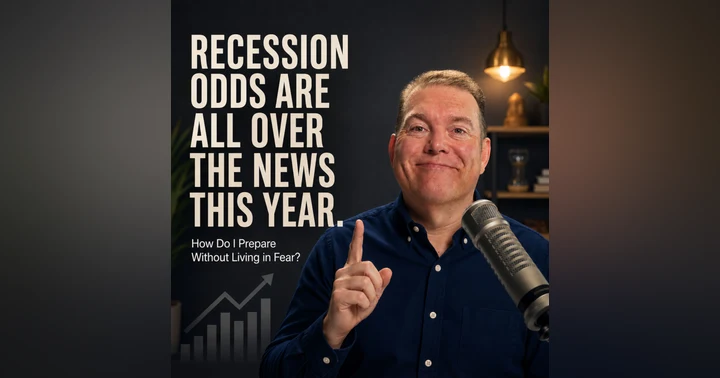
Recession Odds Are All Over the News This Year. How Do I Prepare Without Living in Fear?


Key Takeaways
- Economists are completely split on recession odds this year, leaving regular families dealing with falling consumer confidence and rising financial uncertainty.
- Instead of trying to predict unpredictable economic forecasts or reacting with panic, believers should focus on faithful preparation and wise stewardship.
- Building a robust emergency fund with three to six months of essential expenses is your best defense against unexpected financial surprises.
- Living below your means and maintaining financial margin creates peace of mind and stability no matter what the broader economy does.
- True security is not found in the stock market or your employer, but in trusting God as your ultimate provider while taking practical steps to manage your resources.
Economists are all over the place this year, with recession odds ranging from 30% to 40%, leaving us regular folks scratching our heads. Consumer confidence is taking a nosedive, and many families are feeling the pinch. With all this uncertainty swirling around, how do we navigate our financial futures? Recession Odds Are All Over the News This Year. How Do I Prepare Without Living in Fear? Instead of trying to predict what’s gonna happen, we’re all about prepping for whatever comes our way. So, let's swap that financial fear for some good ol' faithful preparation and get practical about securing our financial peace!
Check out the full podcast episode here
Economists are definitely not on the same page this year, and that’s putting it lightly. Some are throwing out 30% odds of a recession in the U.S., while others are saying, 'Nah, it’s more like 40%.' Talk about a mixed bag of forecasts! But here’s the kicker – consumer confidence is taking a nosedive, and families are feeling the pinch in their wallets. So, what's a person supposed to do when the experts can’t even agree? Instead of getting caught up in the chaos, we’re all about preparing for whatever might come our way. The show dives deep into how to tackle economic uncertainty with a chill attitude – think of it as swapping financial fear for smart planning. If you’re feeling anxious about your finances, you’re far from alone. We’ll discuss how to build an emergency fund (yes, that old chestnut!), live below your means, and focus on the long game with your investments. Spoiler alert: fear-driven decisions are a no-go in our book. So, let’s get prepped and stay cool, friends!
Takeaways:
- Economists are totally mixed on recession odds, with some saying 30% and others 40%.
- Consumer confidence is dropping like it's hot, and families feel their finances are on the decline.
- Even if experts can't agree, we need to focus on what we can control, like saving money.
- Building an emergency fund is crucial now, as it can help you deal with unexpected situations.
Links referenced in this episode:
💛 Join the Financially Confident Christian Community
If today’s episode encouraged you, we’d love to invite you to be part of something bigger — the Financially Confident Christian Community.
This is where faith and finances come together — a growing family of believers supporting one another, sharing encouragement, and helping spread God’s truth about money.
Your membership helps keep the show free for everyone while funding new devotionals, study guides, and outreach resources.
👉 Learn more and join the mission at financiallyconfidentchristian.com/join
Together, we’re helping believers everywhere break the cycle of financial shame and live with confidence in Christ. 🙏
Get Ralph's Book on becoming a Financially Confident Christian financiallyconfidentchristian.com/becoming
WATCH NOW ON YOUTUBE (OUR VIDEO VERSION)
WATCH NOW ON RUMBLE (OUR VIDEO VERSION)
Please share our Podcast with all your friends and family!
Submit your questions or ideas for future shows - email us at
ralph@askralph.com or leave a voicemail message on our podcast page
Thank you for listening to the Ask Ralph podcast. We encourage you to follow us on our social media pages and rate our show. For more information about the topics discussed on the podcast visit Saggio Accounting+PLUS.
Frequently Asked Questions
What are the recession odds this year according to economists?
Economists are completely divided, with various experts estimating recession odds anywhere from 30% to 40%, leaving families with a mixed bag of forecasts.
Should I stop investing if recession odds are high?
No, you should avoid fear-driven investment decisions and panic selling, which lock in permanent losses. Stick to a long-term investment plan instead of reacting to daily headlines.
How can I prepare my finances for economic uncertainty?
You can prepare by building an emergency fund, living below your means, cutting unnecessary expenses, and investing in your own professional skills to increase your earning potential.
How should a Christian handle financial anxiety during a potential recession?
Christians should replace financial fear with faithful preparation, remembering that God is the ultimate provider who remains faithful through every economic season.
00:00 - Untitled
00:37 - Untitled
00:46 - Economic Uncertainty and Consumer Confidence
01:46 - Preparing for Economic Uncertainty
05:00 - The Importance of Emergency Funds
08:41 - Investing in Yourself as a Financial Strategy
11:28 - Financial Preparedness and Faithful Stewardship
13:40 - Facing Uncertainty with Faith
Speaker A
Economists this year can't even agree with each other. Some put recession odds in the United States at 30%. Others put it closer to 40%. But here's the truth.Consumer confidence has fallen to some of the lowest levels in years, and a lot of families say their finances feel like they're getting worse, not better. So when even the experts are split, how are you supposed to know what to actually do? Economic uncertainty is nothing new.We've seen it from time to time. But this year's headlines are generally more mixed than usual.The goal isn't predicting which forecast is right, it's preparing regardless of which one comes true. So stay with me today, and let's replace financial fear with faithful preparation. That's what we're going to talk about on today's show.Hello and welcome to Financially Confident Christian. My name is Ralph Estep Jr. I'm your guide on our odyssey of talking about what we're hearing about in the news and what is real on the ground.So today we're going to talk about preparing wisely for economic uncertainty in a year when we're genuinely seeing mixed forecasts. The experts don't even know what's going on. And I got a listener question that asked me this, what if a recession is coming, Ralph?Should I stop investing? Should I change everything I'm doing financially?And I'm going to tell you right now, when professional economists disagree with each other, it's no wonder regular families feel unsettled. If you're feeling unsettled, today is the show for you. Now, maybe you've got a question for this show.Maybe it's not something as big as this, but go to financiallyconfidentchristian.com/question, type in your question and and I'll answer your question right here on the show. We'll put that in the show notes. But again, it's financiallyconfidentchristian.com/question Let's get right to today's listener question.Listener writes this hi, Ralph. I've been trying to follow the economic news this year to figure out if I should be worried. And honestly, it's made things worse instead of better.One report says recession risk is at 30%. Another says 40 and 80. Everyone seems to be watching the same handful of warning signs and reaching different conclusions.On top of that, I keep seeing surveys saying people's confidence in the economy is at some of the lowest points in years, and a lot of families say their own finances feel like they're getting worse. That matches how I've been feeling, too, even though nothing Dramatic has actually happened to my job or my income yet.Ralph, I don't want to ignore real warning signs, but I also don't want to make big financial changes just because I'm anxious. How should I actually be thinking about this? Thank you. Well, thank you.What a great question, and I totally get it, because you listen to any news forecast, you're going to hear, this expert says this. This expert says something different. And when professional forecasters can't agree, what do you do? What's the wise response for preparation?Not some prediction. But today I want to focus on the things that you can actually control. So we're going to get real practical here.Number one thing, and yes, Ralph's going to mention emergency funds again. We got to start there. In uncertain times, this is the most important time to have an emergency savings fund. I'm going to give you a great example.This happened in my own family last Friday. I was sitting here in my studio recording, and my telephone went off.And I'm like, it's very unusual for my wife to call me in the mornings because she knows my normal routine as I'm recording. And I didn't answer it right away.And as soon as I was done hitting that recording, I called her and she says, our son is on the way to the emergency room. And I said, oh, my God, is he okay? She goes, well, he's having some pain in his stomach. I said, well, that's not good.So, long story short, he went to the emergency room. They gave him a complete checkup, they ran some tests, all that kind of stuff. And they said, you're fine.But here's the thing that he wasn't prepared for. He's got health insurance, but his deductible is a big number.And as he was leaving the hospital, he said to me, he said, dad, he said, you know what? You always harp about these emergency funds. He says, I actually have one now. And now I'm not so worried about this copay.That bill when it comes from the hospital. See, that's a real life example of why you need an emergency fund. We've talked about this the other day. Emergency funds depend on your situation.So build that three to six months of essential expenses, depending upon what your job looks like. Like, it might be more than that. And listen, if you're not there right now, a lot of people, they don't have $1,000. They don't have $500.I'm not telling you to stop where you are. Start there, but keep making some steady progress. Try to build that number. Especially in the economic times we're in right now.Every dollar that you save increases your flexibility no matter what the economy actually does. Hey, if the economy does great, that's even better. Now you've got a bigger emergency fund. You can't control the economy, none of us can.But you can strengthen your own foundation. Here's another tip, and this is one I tell every single person I have the opportunity to talk to. Keep living below your means.You're thinking, oh, Ralph, that sounds like a lot of fun. I'm gonna live below my means. That is the secret to financial success. A lot of people talk about margin. Yes, margin creates stability.That margin is great because no matter what the economic forecast becomes, it always works. If you avoid expanding your lifestyle. Every time your income grows, you're living below your means. Spend less than you earn.Keep that unnecessary debt down. Build that financial breathing room. Because it becomes incredibly valuable if conditions do tighten this year.That margin you're building today, living below your means becomes peace of mind tomorrow because you're not as much worried about it. But at the same time in your email you mentioned this fear based investment decisions. And I hear this all the time in the press.Here's the thing I want to tell you. This is a truism of the markets. Markets rise and fall, that's normal. Even when they're split forecast by the people who are the gurus of this.Markets rise and fall, that's a normal thing. You've got to have a long term investment idea. It's about patience.If you think you're going to go buy investments and make a million dollars tomorrow, that will get you in trouble. And when you sell because of fear, most of the time that locks in losses that you're never going to be able to recover from.You got to focus on a long term plan rather than reacting to each new headline. This is why I tell people, don't look at your investment statements every day.Don't log into your investment account every day because you will live in constant fast fear. Those temporary headlines shouldn't rewrite a long term strategy. But here's things you can invest in and a lot of people don't think about this.Invest in your ability to earn more when you see hiring slower. We talked about this the other day. When we see people being replaced by AI, we see people being replaced by automation.You got to learn how to be more valuable and adaptable. This is a time to learn new skills. So many people get in their job and they just get Stuck. They don't move on.This is a great time to learn new skills, build those relationships, improve yourself professionally. One of the things that I tell a lot of people is add additional income streams.If your current role feels less secure, go figure out other ways to make extra money. It may be extra. Extra. That's fantastic. The greatest financial asset is your own ability to create value.If you can create value for what you're able to bring to the market, that is the best economic scenario there is. One of the smartest investments, by far the smartest investment you can ever make is investing in yourself. Now, put all what I just set aside.You also have to remember who your actual provider is. Your employer isn't your ultimate provider. The economy we're living in is not the ultimate provider. The stock market isn't your provider.This shows all about faith and finance. God is your provider. Doesn't matter which economist turns out to be right this year. In the end, God is our provider.Wise planning and deep trust belong together, not one instead of the other. Our security isn't found in some perfect economic conditions. It's found in a true and faithful God. Now, I want to go a little deeper here.Because throughout history, God's people have lived throughout droughts. They lived throughout famines and wars and recessions and uncertainty. Every single generation has faced seasons when the future looked unclear.And this year it does look unclear. I'm not going to sit here and sugarcoat it. Even the professional studying the numbers can't agree on what's coming.But here's something I can guarantee you is coming. God's faithfulness has never depended on which forecast turns out to be correct. Here's what faith doesn't promise us.It doesn't promise us that difficult seasons won't come. They're going to come. We are going to go through storms in life.It doesn't promise us that if we make investments, they're never going to decline in value. They probably will. And it doesn't promise us that our career is never going to face challenge, even in an uncertain job market like this one.But it does promise some very good things. God remains faithful in every single season. He doesn't rely on the GDP or the recession, odds or any of those things. He gives us wisdom for today.He gives us strength for tomorrow. And it gives us peace that circumstances cannot ever take away. The beauty of God's love for us is it never changes.His character never changes, even when economic forecasts do. Friend, fear is a poor financial advisor. Peace grows through trust. Hope Always has the final word.The economy is going to rise and fall and the experts are going to always disagree. But God's faithfulness never changes. So don't let split forecast steal your peace today. Prepare wisely.Yes, trust in the Lord deeply, but keep moving forward. Preparedness isn't fear, it's faithful stewardship. So here's your win for today. We're going to get super practical.Perform a financial preparedness check, go look at your emergency fund, update your monthly budget, look at some unnecessary expenses to eliminate. Identify one way to increase your earning potential this year. Grow yourself professionally. Being prepared isn't living in fear.It's faithful stewardship. Which leads me to today's Bible verse. It comes to us from Isaiah, chapter 41, verse 10. Don't be afraid, for I am with you.Don't be discouraged, for I am your God. I will strengthen you and help you. I will hold you up with my victorious right hand. I don't know about you, but that's a mic drop moment, isn't it?God speaks directly to our fears, even those fears that are backed by real conflicting economic data. He doesn't promise us that difficulty isn't going to come. What does he promise us? He promises us that we won't face it alone.Never will we face it alone. That confidence that we all can have grows when trust is rooted in Him. Instead of the latest forecast, let's pray together right now.Heavenly Father, thank you for being our constant source of hope in an uncertain world. Even in a year when the experts themselves can't agree, you laugh at them, don't you, God?So when conflicting headlines create anxiety in us, Lord, remind us that you are still in control no matter what goes on in the economy. Give us wisdom, Lord, and help us prepare faithfully. And give us courage to make wise financial decisions with the money you give us to steward.Give us peace that isn't shaken by economic uncertainty or by split forecasts, Lord, and help us trust you more than the news. Help us trust you more than the markets and help us trust you more than our own fears.And may our confidence always rest in your unchanging faithfulness. And we ask this in the name of Jesus. Amen, friend. Even professional economists disagree this year.So we're living in uncertainty, but it doesn't require panic, it just requires wisdom. So strengthen your emergency fund, live below your means and stay committed to your long term investment plan.Grow your skills and remember in the end who your true provider is, regardless of which forecasts prove. Right now, maybe you've got a question for this show. I'd love to answer it. I'd love to hear your voice.You can record a voicemail message for me by going to financially confidentChristian. It is super simple. We'll put a link right in the show notes. You just click on that click record and I'll hear you again.That's financiallyconfidentchristian.com/voicemail I just want to thank you for joining me today. I want to encourage you to stay financially savvy, know who the true provider is. May God bless you and you have a great day. I.